


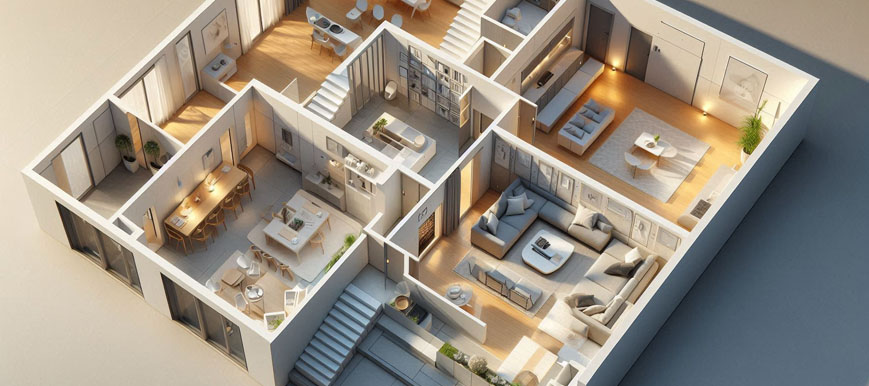
In the field of 3D floor plans, "3D Floor Plans - Communicating Space Efficiently" represents the intersection of design, technology, and storytelling. As projects become increasingly complex, 3D floor plans help teams justify decisions, align stakeholders, and communicate spatial intent clearly.
Clients and stakeholders benefit from clear visualization of space. Traditional 2D plans often fail to convey scale, proportions, or furniture layout. Interactive and photorealistic 3D floor plans allow clients to visualise room relationships, circulation, and overall functionality before construction begins.
Integration between BIM, CAD, and real-time rendering tools streamlines collaboration across architects, designers, and contractors. This reduces errors, minimizes costly changes during construction, and ensures that visual representation aligns with design intent.

“3D floor plans allow clients and designers to understand and optimise spatial layouts before the first brick is laid.”
Photorealistic renders communicate materials, lighting, and furniture placement, while stylized visualizations can emphasize flow, zoning, or concept. Combining these approaches guides viewers from conceptual understanding to practical decision-making.
Web-based viewers, interactive walkthroughs, and VR overlays enhance client engagement, allowing stakeholders to explore alternatives and provide feedback in real time. This transforms traditional presentations into collaborative design sessions.
3D floor plans can integrate energy-efficient strategies, natural light analysis, and furniture optimisation to illustrate sustainability and cost-effective solutions. This enhances client confidence in design decisions.
"3D Floor Plans - Communicating Space Efficiently" highlights how clear visualisation, integrated workflows, and interactive storytelling allow teams to deliver designs with confidence, reduce errors, and align stakeholders effectively.